
What is GEO? GEO, or Generative Engine Optimization, means optimizing your website and your business’s online presence so that AI tools like ChatGPT, Gemini and Google AI Overviews recognize your business, trust it and recommend it in their answers. It’s also called AEO (Answer Engine Optimization) or “SEO for AI.”
Until a few years ago, a customer would search for a service on Google and pick one of ten blue links. Today, many people ask the same question directly to ChatGPT, Gemini or Perplexity: “Recommend a good Persian-speaking clinic in North York” or “Which company in Toronto builds websites for restaurants?” The AI’s answer usually includes only a few names. If your business isn’t one of them, for that customer you practically don’t exist.
That’s where GEO comes in. In this guide, I’ll explain step by step, without jargon, how SEO for AI works and where to start if you want to show up in ChatGPT and Google.
In this article:
What is GEO, and how is it different from SEO?
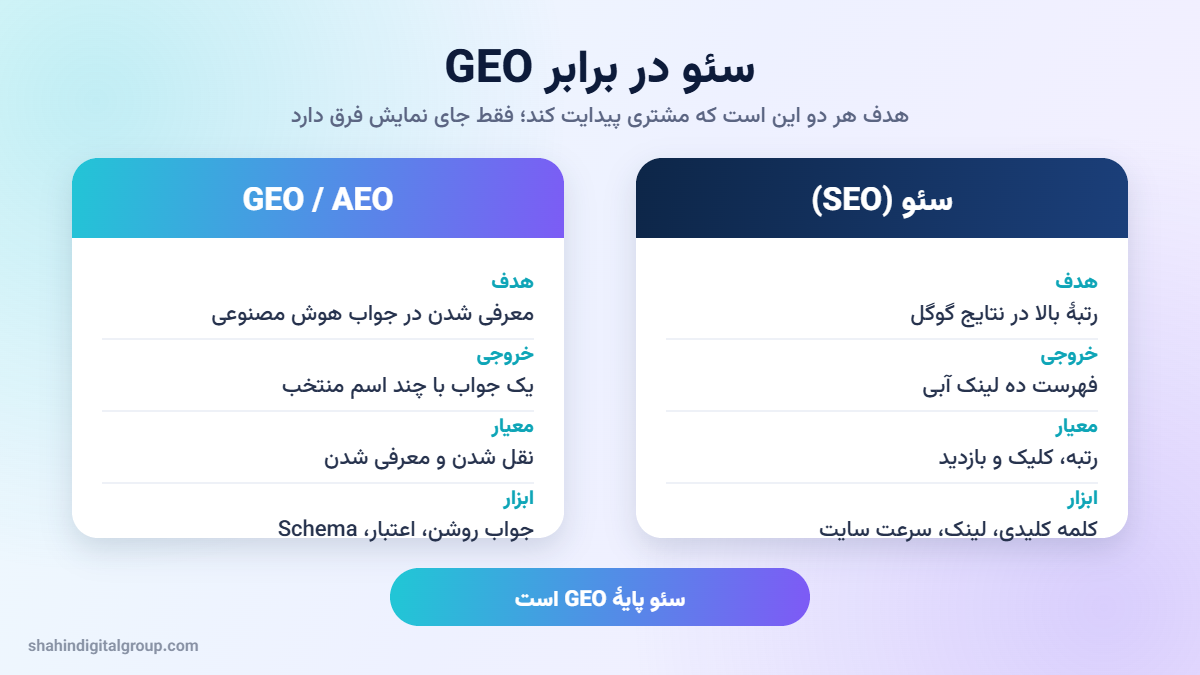
SEO means ranking in Google’s search results. GEO means being chosen in an AI-generated answer. The two aren’t competitors; SEO is the foundation of GEO:
- Google AI Overviews (the AI summary at the top of Google results) draws on the same pages Google has indexed. A site that doesn’t show up in Google won’t show up in AI Overviews either (Google’s official guide).
- ChatGPT uses web results and its own crawler, OAI-SearchBot, to search the web. If this bot can’t read your site, your chances of being cited drop (OpenAI’s official documentation).
- Perplexity and similar tools also read their sources from the web and usually link to them next to the answer.
Here’s the key difference: AI isn’t looking for a page that repeats a keyword. It’s looking for a clear answer from a trustworthy source that’s also confirmed in other places across the web.
7 practical steps to show up in AI answers
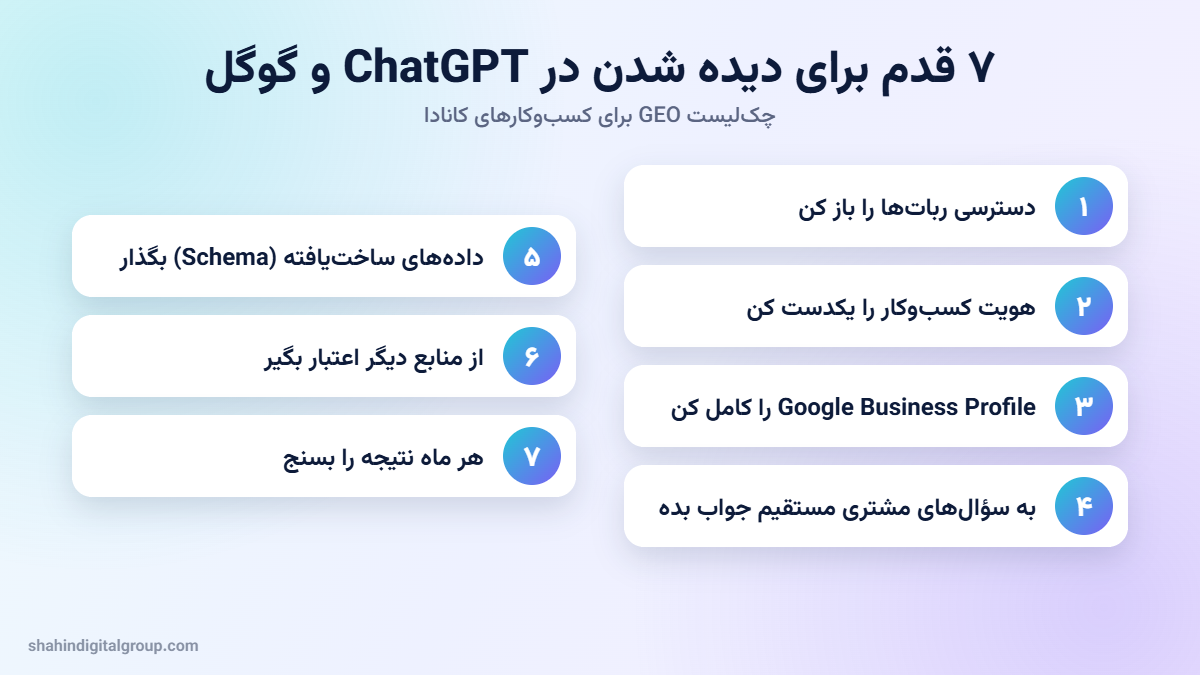
1. Make sure bots are allowed to read your site
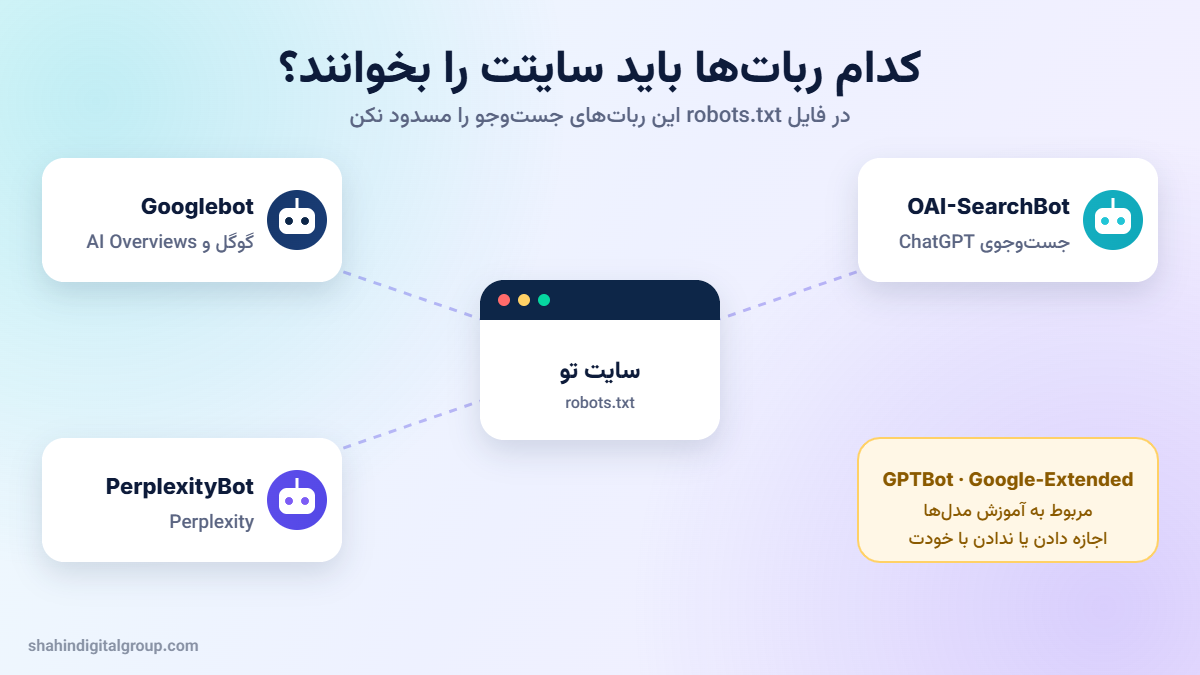
Many websites block AI bots without their owners knowing, usually through a firewall security setting or an old robots.txt file. Check your site’s robots.txt file (it lives at yoursite.com/robots.txt) and make sure these bots aren’t blocked:
- Googlebot: for Google Search and AI Overviews
- OAI-SearchBot: for ChatGPT search
- PerplexityBot: for Perplexity
Note: bots like GPTBot and Google-Extended relate to using content for model training. Whether you allow them is your call, but blocking them doesn’t stop you from appearing in search. What matters is not blocking the search bots by mistake.
2. Keep your business identity consistent everywhere
AI pieces information together from many sources. If your name, phone number or service area differs between your website, Google Business Profile, Instagram and directories, its trust in your business drops.
A tip for Iranian-owned businesses: pick one English spelling for your name and use it everywhere. If you write “Shahin” in one place and “Shaheen” in another, a machine may treat them as two different businesses.
3. Keep your Google Business Profile complete and active
For local businesses, Google Business Profile is one of the most important sources Google uses. Take the right category, your list of services, business hours, real photos and especially real customer reviews seriously, and reply to reviews. If you don’t see customers in person, set up your profile as a Service Area business without showing your address.
4. Answer real customer questions directly
AI loves clear answers. Instead of generic lines like “We provide the best service,” write pages that answer specific questions:
- “How much does a website for a small restaurant in Toronto cost?”
- “How many sessions does a hair transplant take in Canada?”
- “Do you offer services in Persian?”
A simple rule: answer first, then explain. Give the short answer in the first sentence of each section, then add the details. Add a real FAQ section to every service page, too. If your customers speak both Persian and English, have this content in both languages.
5. Add structured data (Schema)
Schema is code that explains, in machine language, what your business is: its name, type of service, service area, contact methods and social media profiles. The most important types for most businesses:
- LocalBusiness or Organization to describe the business itself
- Service for service pages
- FAQPage for your FAQ section
In WordPress, plugins like Rank Math handle much of this without any coding.
6. Get others talking about you
AI doesn’t just take your word for it. When your business also appears in independent sources, your chances of being recommended go up:
- Real customer reviews on Google and review sites
- Listings in reputable Canadian directories and Iranian community directories
- Interviews or features in local media and podcasts
- Partnerships and links from related businesses
7. Measure the results
Every month, try a few questions your customers actually ask in ChatGPT, Gemini and Perplexity, and see whether your name comes up and, if it does, from which source. In Google Analytics, track visits from chatgpt.com and perplexity.ai separately. These numbers show whether your work is paying off.
Common mistakes
- Relying entirely on Instagram: Instagram content is great for connecting with customers, but AI relies mostly on websites and text sources to answer questions. Your website is the main home for your business information.
- Repeating keywords for no reason: this old SEO trick does more harm than good in the age of AI.
- Accidentally blocking bots: some hosting or firewall security settings block search bots too. Checking once doesn’t hurt.
- Outdated information: business hours or services you no longer offer reduce the trust of both machines and customers.
A simple example
Say you run a Persian-speaking beauty clinic in North York (this is a hypothetical example). To show up for the question “Persian-speaking beauty clinic in North York”:
- Have a page on your site that answers exactly that question: where you are, what services you offer and that you also serve clients in Persian.
- List the same information, with exactly the same name, on your Google Business Profile and in directories.
- Ask happy customers to leave a Google review and naturally mention the service in it.
- Add LocalBusiness Schema to your site.
- Next month, ask ChatGPT and Gemini the same question and see what changed.
The bottom line
GEO isn’t magic, and it doesn’t work overnight. It’s the same solid SEO work, with more focus on clarity, trust and consistent information. The good news: most of your competitors haven’t started yet, so any business that starts now gets ahead. If you’d like to do this together, take a look at our SEO and GEO services.
Frequently asked questions
What is GEO?
GEO, or Generative Engine Optimization, means optimizing your website and business information so that AI tools like ChatGPT, Gemini and Google AI Overviews recognize your business and recommend it in their answers.
Do I need to give up SEO for GEO?
No. SEO is the foundation of GEO. A site that Google hasn’t indexed properly is also less likely to show up in AI answers.
How long does it take to see results?
It depends on your site’s current state and your competition. Technical fixes like unblocking bots take effect quickly, but building credibility and customer reviews takes months.
Does a small business stand a chance?
Yes. For local and specialized questions (for example “in Persian” or “in a specific neighbourhood”), small businesses with clear, consistent information have a good chance of being recommended.
About the author: Zar Shahin is a Toronto-based digital marketing specialist focused on SEO and AI search (GEO/AEO), Google and Meta ads, and marketing automation with n8n and AI agents. Founder of Shahin Digital Group.
Want to know where your business stands in AI answers right now? Book a free consultation and we’ll review it together. We work in Persian, English and French.